------------------------------------------________________
How Afrikanet Brings 4G and 5G Connectivity to the Most Remote Corners of Africa
In many parts of Africa, connectivity is more than a luxury — it is a lifeline. Yet some communities still live far beyond the reach of fiber cables, electrical grids, and even proper roads. These are places where traditional telecom infrastructure simply cannot go. But through innovative engineering and a commitment to digital inclusion, Afrikanet has developed a system that brings modern 4G and 5G connectivity to the most isolated areas of the continent.
1. A Different Approach to Rural Connectivity
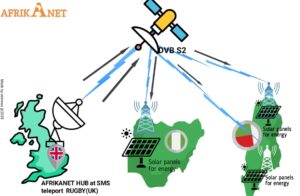 Traditional mobile networks depend heavily on fiber backbone, stable electricity, and ground infrastructure. Rural regions often have none of these. This is why Afrikanet uses a completely different approach: satellite connectivity combined with solar-powered towers.
Instead of waiting for fiber to reach a remote area, Afrikanet beams the connection directly from the sky.
From the SMS Teleport Hub in Rugby, UK, high-speed internet is sent to a satellite, which then delivers the signal down to rural BTS (Base Transceiver Station) sites spread across Africa.
This is where the most important part comes in: backhaul.
2. Backhaul: The Hidden Link That Connects Rural Africa to the World
Backhaul is the essential connection between a mobile tower and the core network. In cities, this is usually done through fiber optic cables. But in remote African villages, fiber is either too expensive, too slow to deploy, or physically impossible due to terrain.
Afrikanet solves this with satellite backhaul.
Here’s how it works:
A satellite beam carries the internet from our UK hub.
Rural sites receive it using a small VSAT dish.
The signal is then distributed through a 3G/4G/5G BTS tower.
Solar power keeps everything running 24/7, even without electricity.
This invisible link — the backhaul — is what transforms a simple mast into a fully functional mobile network. Without it, the tower would have no connection to the internet. With it, entire villages get instant mobile coverage.
3. Madagascar: Bringing 4G/5G to the Unreachable
Madagascar is a perfect example of why satellite backhaul is essential. Many communities here are surrounded by forests, mountains, or cut off by long distances. Traditional infrastructure would take years to reach them.
But Afrikanet deployed a simple yet powerful solution:
This setup brings connectivity to places that have never had mobile signal before. Phones that were offline for years suddenly come alive with 4G. Students, farmers, health workers, and businesses all gain the opportunity to participate in the digital world.
4. Nigeria: Keeping Rural GSM Sites Online with Satellite Backup
In Nigeria, Afrikanet extends this technology further through AfrikaStar, which acts as a backup connection for rural GSM towers.
Fiber cuts happen frequently. Generators fail. Power outages can last for hours. Without a backup link, entire regions lose network coverage.
But satellite backhaul fixes this problem.
When the main link goes down, satellite instantly takes over — keeping the GSM site online and ensuring continuity for thousands of people. Rural customers stay connected, and operators avoid service disruptions.
5. Beyond Technology: The Human Impact
For Afrikanet, satellite backhaul and solar-powered towers are not just technical solutions. They are tools that change real lives.
With reliable connectivity:
Doctors can reach hospitals and specialists
Students can access online learning
Farmers can check market prices and weather forecasts
Businesses can offer digital services
Families can communicate across long distances
Connectivity opens doors to education, safety, economic opportunity, and social inclusion.
6. The Future: Connecting the Places Everyone Else Forgot
With satellite backhaul, renewable energy, and innovative engineering, Afrikanet continues to expand connectivity across Africa. Every new tower built in a rural area is more than a piece of infrastructure — it is the beginning of opportunity.
Afrikanet’s mission is clear:
To bring modern connectivity to the places everyone else forgot — and to ensure no community is left behind.