
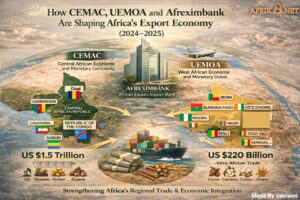
Africa’s export landscape is no longer driven solely by individual countries. Regional economic blocs and financial institutions are increasingly defining trade outcomes, export growth, economic stability, and integration. Three key actors are central to this story: the Central African Economic and Monetary Community CEMAC, the West African Economic and Monetary Union UEMOA, and the African Export-Import Bank Afreximbank. Each plays a unique but interconnected role in driving Africa’s exports, diversifying markets, and strengthening regional economic integration.
1. Pan‑African Trade Growth (2024 Trends)
According to the most recent African Trade Report by Afreximbank, Africa’s total merchandise trade (exports + imports) rebounded strongly in 2024, reaching approximately US$1.5 trillion, up 13.9% from the previous year after a contraction in 2023. Ecofin Agency
Within this total, intra‑African trade — trade between African countries — grew by 12.4% to US$220.3 billion, signaling stronger continental integration and higher flows of goods across regional borders. Ecofin Agency
Despite this growth, Africa’s share of global exports remains relatively low — around 3.3% of global trade — highlighting ongoing challenges in global market access and export diversification. Ecofin Agency
2. The Role of Afreximbank in Export Growth
Afreximbank is a leading financial institution dedicated to facilitating African trade. In 2024 alone:
It helped drive the rebound in continental trade after global headwinds. Ecofin Agency
It supports trade finance and export‑related credit across Africa, with plans to expand financing to US$40 billion by 2026 to address persistent funding gaps affecting export growth. Ecofin Agency
The bank’s support is especially critical in markets where traditional lenders are reluctant to provide capital, and it underpins many African exporters’ ability to participate in both intra‑continental and global trade.
Afreximbank’s 2025 African Trade Report also shows that major African exporters such as South Africa, Côte d’Ivoire, Egypt, Nigeria, and Zimbabwe dominated intra‑African trade flows in 2024, reflecting a mix of industrial and commodity export strength. Pulse Uganda
3. Nigeria and Regional Export Dynamics
In West Africa, Nigeria emerged as the region’s largest intra‑African trading country in 2024, with approximately US$18.4 billion in trade with other African nations — up from US$8.1 billion in 2023. This reflects rising exports of both crude oil and refined petroleum products, the latter supported by new capacity from local refineries. Nairametrics
This increase illustrates how industrial upgrades — like refining instead of simply exporting raw products — can expand value capture and trade within African markets themselves.
4. CEMAC: Central Africa’s Resource‑Heavy Export Bloc
The CEMAC zone includes six Central African countries sharing the Central African CFA franc(Cameroon, Central African Republic, Chad, Republic of the Congo, Equatorial Guinea, Gabon). While up‑to‑date aggregate 2024 export figures for CEMAC as a region are limited, historical research shows that crude petroleum and hydrocarbons dominate CEMAC exports — accounting for the vast majority of export earnings. World Trade Organization
For many member states such as Gabon, Congo, and Equatorial Guinea, oil and gas revenues remain the largest sources of foreign exchange and fiscal revenue. Wikipedia
This dependency on natural resource exports has shaped CEMAC’s economic policy, exposing the region to global commodity price swings. Despite that risk, resource exports provide essential foreign currency inflows and government revenues that support public spending and infrastructure.
5. UEMOA: West Africa’s Monetary Union and Export Base
The UEMOA zone (Benin, Burkina Faso, Côte d’Ivoire, Guinea‑Bissau, Mali, Niger, Senegal, and Togo) uses a common currency (the West African CFA franc) and aims to harmonize trade and monetary policy.
Although specific 2024 export values for UEMOA as a bloc aren’t fully published, trade integration in the region continues to deepen — with export sectors led by agricultural goods (cocoa, cotton, cashews, and grains) and increasing efforts to diversify into processed foods and manufactured products. UMOA-Titres
UEMOA’s success shows how monetary coordination and shared trade policy can reduce costs and strengthen export competitiveness across borders.
6. Export Patterns and Regional Trade Integration
Beyond raw totals, the African Trade Report highlights how export patterns are evolving:
Southern Africa, including South Africa, remains the largest contributor to intra‑African trade, accounting for roughly a quarter of exports within the continent. media.afreximbank.com
Western Africa — with countries like Nigeria and Côte d’Ivoire — follows closely, showing strong growth in both intra‑African and global export markets. media.afreximbank.com
Eastern, Northern, and Central Africa also increased export volumes in key commodities and manufactured goods, reflecting broader diversification trends. media.afreximbank.com
These patterns show that regional integration, improved infrastructure, and trade agreements like the African Continental Free Trade Area (AfCFTA) are beginning to bear fruit in export performance, though much work remains to enhance connectivity and capacity.
7. Why Africa’s Export Growth Matters
Exports play a critical role in Africa’s economic transformation:
They bring vital foreign exchange needed to pay for imports and stabilize currencies.
They support job creation in agriculture, manufacturing, logistics, and services.
They help governments invest in infrastructure, health, and education.
They reduce dependency on foreign aid and debt.
However, Africa still faces structural challenges such as limited export diversification, infrastructure gaps, and restricted access to affordable trade finance — issues Afreximbank and regional communities continue to address.
Conclusion: A Stronger Export Future
The export performance of Africa’s regional blocs and financial institutions suggests a continent in transition — one where internal trade is rising, regional cooperation is strengthening, and new economic linkages are emerging. With continued support from institutions like Afreximbank, and deeper integration under frameworks such as AfCFTA, African exports are positioned not just to grow in value, but to diversify in structure, supply chains, and global relevance.
The future is bright. keep the good work