
-----------------------------------------------------------------------------------------------
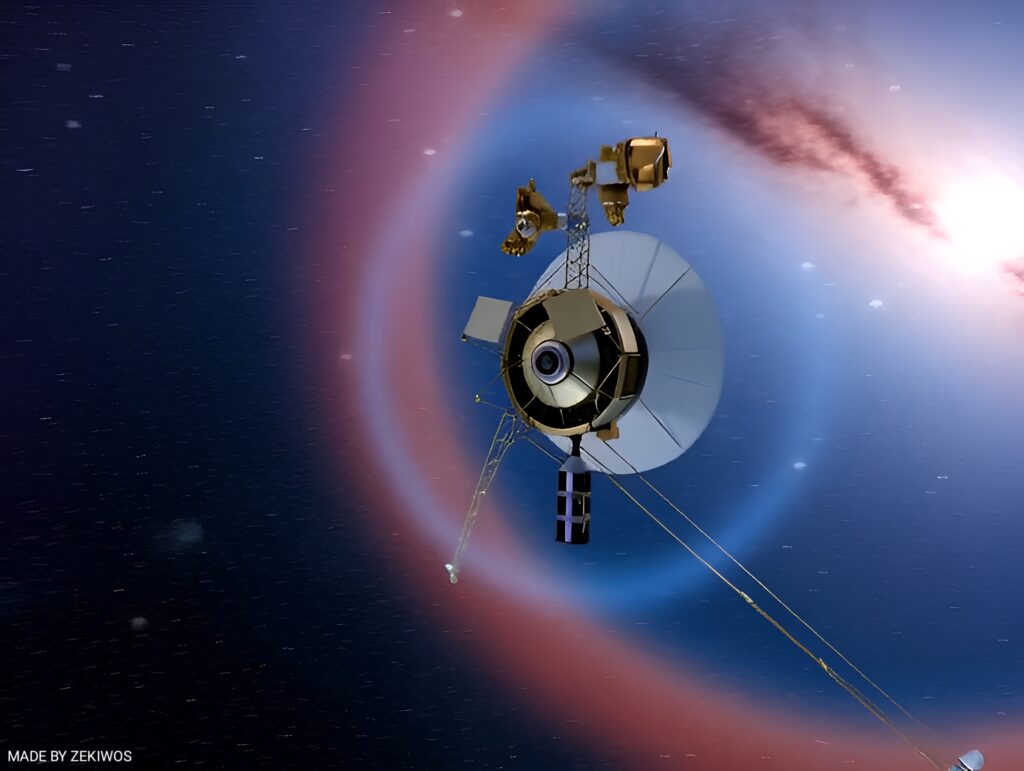
“This is the farthest thing mankind has ever made.”
That statement isn’t just dramatic — it’s literal. Nearly 50 years after leaving Earth, Voyager 1 continues to drift through the darkness between stars, farther from home than any human‑built object ever has. But how did a mission designed for a few years become one of the most historic journeys in human exploration? This is the full story — from planetary discoveries to interstellar science, from golden time capsules to cosmic distances no one thought we’d cross.
1. A Rare Opportunity: The Birth of Voyager
In the 1970s, NASA saw a once‑in‑176‑years planetary alignment — where Jupiter, Saturn, Uranus, and Neptune would line up in a way that made visiting multiple outer planets possible with minimal fuel. This opportunity inspired the ambitious Voyager program with two probes, Voyager 1 and Voyager 2, built to take advantage of this alignment.
Voyager 1 was launched on September 5, 1977, just shortly after its twin, Voyager 2, for a planned tour of Jupiter and Saturn — and nowhere beyond. Engineers expected the craft to function for only about five years. Encyclopedia Britannica
2. The Mission That Kept Going
Voyager 1’s early mission was straightforward:
March 5, 1979: Flyby of Jupiter, capturing detailed images of the planet’s clouds, giant storms, and ring system.
November 12, 1980: Close encounter with Saturn, including breathtaking views of its rings and moons.
These encounters weren’t just snapshots — they rewrote textbooks. Voyager revealed volcanic activity on Jupiter’s moon Io, the complex structure of Saturn’s rings, and much more (data verified later by follow‑on missions like Galileo and Cassini). Encyclopedia Britannica+1
After Saturn, scientists realized the spacecraft’s path could send it out of the solar system. So in 1990, as both Voyagers slipped beyond the planets, NASA officially began the Voyager Interstellar Mission — a new phase focused on exploring space beyond our Sun’s influence. NASA
3. A Time Capsule Floating Through Space — The Golden Record
Voyager 1 carries something unlike any other scientific instrument — the Golden Record, a 12‑inch gold‑plated copper disk meant as a message to any intelligent life that might encounter the spacecraft in the distant future. NASA Science
The record was compiled under the guidance of American scientists, including Carl Sagan, and includes:
115 images from Earth
Natural sounds (birds, wind, thunder)
Music from many cultures
Greetings in 55 languages
Schematics explaining how to play the record if found
The cover even includes instructions showing Earth’s position relative to certain pulsars — like a cosmic “map” telling where we came from. NASA Science
This remarkable concept transformed Voyager from a purely scientific probe into a cultural ambassador — a message in a bottle cast into the vast ocean of space.
4. Leaving the Solar System — The Greatest Leap
One of the biggest milestones in space history came on August 25, 2012, when Voyager 1 entered interstellar space, becoming the first human‑made object to leave the solar system and travel into the space between stars. NASA Jet Propulsion Laboratory (JPL)+1
That means Voyager isn’t just far — it passed the boundary where the Sun’s influence fades and the interstellar medium begins. Signals from the spacecraft now take nearly a full day to reach Earth — better described today as a light‑day away (about 16 billion miles or 25+ billion kilometers). Tom’s Hardware
This achievement opened a whole new frontier — as Voyager became a first‑hand scientific probe of the environment between star systems, giving insights into cosmic rays, plasma waves, and magnetic fields in a region humanity had never directly measured.
5. Engineering Marvel: How Voyager Still Works
Voyager 1 was built with technology from the 1970s, yet nearly five decades later, it still returns data. Here’s how:
Power
Voyager is powered by radioisotope thermoelectric generators (RTGs) — nuclear batteries that convert heat from radioactive decay into electricity. While output steadily drops each year, they have kept the spacecraft functioning far beyond expectations. Space
Instruments
At launch, Voyager carried 10 scientific instruments, including:
Cameras and imaging systems
Magnetometers
Spectrometers
Particle detectors
Over time, NASA has shut down instruments to conserve power, leaving only a few still operating — but enough to return valuable interstellar data. AP News
Thrusters & Communication
In 2025, engineers reactivated a key thruster that had been dormant for 21 years — a maneuver described as a “miracle save,” extending the mission further. Le Monde.fr
Despite the massive distance, NASA’s Deep Space Network (DSN) still receives signals from Voyager — incredibly faint, often described as a fraction of a billion‑billionth of a watt — proving humanity’s reach across space isn’t just metaphorical. NASA
6. Science Beyond the Sun
Voyager 1’s scientific legacy is profound:
Planetary Discoveries
Discovered volcanic activity on Io
Found new moons around Jupiter and Saturn
Showed Saturn’s rings as far more dynamic than imagined
These discoveries shaped future missions and vastly improved our understanding of the solar system. NASA
Interstellar Data
Voyager 1 provides the only in‑situ measurements of interstellar space — including observations of plasma waves and cosmic ray variations — unique data that ground‑based telescopes can’t obtain. arXiv
Every year, its instruments reveal something new about how our galaxy’s plasma and magnetic fields function beyond the Sun’s influence.
7. Legacy & Cultural Impact
Voyager’s story isn’t just science — it’s cultural mythmaking. The Pale Blue Dot photo (taken in 1990) immortalized Earth as a tiny speck against the vastness of space, inspiring Carl Sagan’s famous reflections on human fragility and unity. NASA
The Golden Record continues to spark dreams about extraterrestrial contact and shared human experience, even though it may take tens of thousands of years before it might approach another star system. NASA Science
8. What Comes Next? Voyager & Human Exploration
Voyager 1 is expected to operate until the 2030s, when its last instruments will fall silent due to power loss. After that, it will continue drifting for millions of years.
Even then, it will continue to represent the first step into the galactic neighborhood, inspiring future missions — including proposals for dedicated interstellar probes that could travel faster and go even farther. Reddit
Sources & Further Reading
Here are the key references used in this blog (embedded above):
NASA Voyager 1 overview and mission stats — https://www.jpl.nasa.gov/missions/voyager-1 NASA Jet Propulsion Laboratory (JPL)
Voyager facts and history (Britannica) — https://www.britannica.com/topic/Voyager-1 Encyclopedia Britannica
Voyager science and discoveries — https://science.nasa.gov/mission/voyager NASA Science
Golden Record details — https://science.nasa.gov/mission/voyager/voyager-golden-record-overview NASA Science
Mission legacy and interstellar space journey — https://www.nasa.gov/news-release/nasa-spacecraft-embarks-on-historic-journey-into-interstellar-space NASA
Recent spacecraft updates (thruster restart) — news from NASA via Le Monde Le Monde.fr
Mission extension and instrument shutdowns — news from NASA via AP AP News
One light‑day milestone (2026) — https://www.tomshardware.com/tech-industry/after-nearly-fifty-years-voyager-1-spacecraft-approaches-one-light-day-milestone Tom’s Hardware