
Africa has the youngest population in the world, some of the fastest-growing cities, and one of the biggest digital opportunities of the 21st century. Yet for hundreds of millions of Africans, reliable internet access remains frustratingly out of reach.
In many rural communities, getting online is still expensive, unreliable, or simply impossible. Students struggle to access educational resources, small businesses are cut off from larger markets, and entire communities remain disconnected from opportunities that much of the world now takes for granted.
This is exactly the problem Starlink was designed to solve. By delivering internet directly from a constellation of low-Earth orbit satellites, Starlink offers something that traditional telecommunications companies often struggle to provide: coverage in places where building fiber networks is too expensive and mobile towers are too difficult to maintain.
For many Africans living far from major cities, the technology represents more than faster internet. It represents access—to education, healthcare, business opportunities, information, and the global economy.
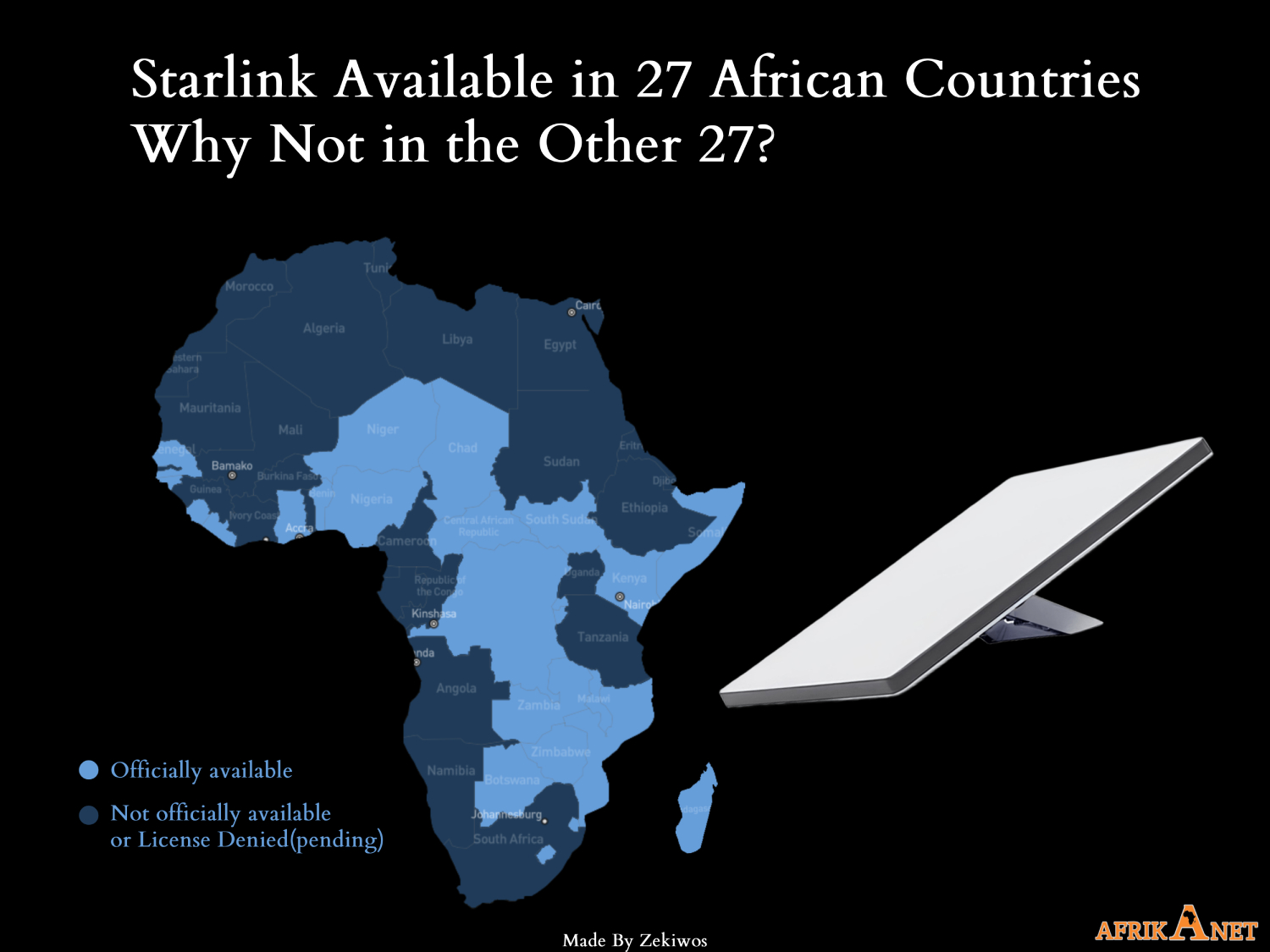
And yet, despite its rapid expansion across the continent, Starlink is officially available in only about half of Africa’s 54 countries.
So why not the other 27? The answer has less to do with satellites and more to do with politics, regulation, economics, and control.
One of the biggest misconceptions about Starlink is the idea that once satellites are launched into orbit, the company can simply start selling internet service anywhere on Earth. That is not how telecommunications works.
Every country has its own laws governing internet services, telecommunications providers, spectrum usage, taxation, and licensing requirements. Before Starlink can legally operate, governments must approve its applications and determine whether the company complies with national regulations. Some countries move quickly Others take years and some decide not to approve it at all.
The result is a patchwork of approvals across Africa, where one country may embrace satellite internet while a neighboring country continues to debate whether it should be allowed.
Protecting Local Telecom Companies
Another factor is competition. Many African governments have spent decades building and regulating domestic telecommunications industries. Telecom operators invest heavily in infrastructure, employ thousands of people, and contribute significant tax revenue. Starlink introduces a completely different model.
Unlike traditional providers, it does not need thousands of cell towers spread across a country. It does not need to lay fiber to every community. Instead, it connects users directly through satellites.
For consumers, that can be a major advantage. For existing telecom operators, it can be a serious challenge. Governments must therefore decide whether introducing Starlink will increase competition and improve connectivity or undermine local companies that have already invested heavily in national infrastructure.Some regulators see opportunity. Others see disruption.
The Question of Control
There is another issue that is discussed less openly but sits at the center of many debates about satellite internet.
Control. Traditional internet networks operate through infrastructure located inside a country’s borders. Governments license that infrastructure, regulate it, tax it, and oversee how it operates. Satellite internet changes that relationship.
When internet access comes from a network orbiting hundreds of kilometers above Earth, governments naturally begin asking difficult questions.
How will regulations be enforced? How will national security concerns be addressed? How will authorities ensure compliance with local laws? These are legitimate questions.
But there is also a broader reality. Some governments are more comfortable with communications systems they can closely monitor and control. Satellite internet challenges some of those traditional assumptions.
That does not automatically mean governments are wrong to be cautious. Telecommunications is a strategic sector, and regulation exists for good reasons.
However, the debate often extends beyond technical concerns and into broader questions about who controls access to information and digital infrastructure.
Regulatory Delays Are Also Part of the Story
Not every country without Starlink is actively blocking it. In many cases, the issue is simply bureaucracy. satellite internet is still relatively new. Regulators must evaluate applications, establish licensing frameworks, coordinate spectrum allocation, and determine how existing telecommunications laws apply to a technology that did not exist when many of those laws were written. That process can be slow.
In some countries, the delay reflects caution rather than opposition. But for people waiting for better internet access, the distinction may not matter. Whether a service is blocked, delayed, or still under review, the outcome is often the same: it remains unavailable.
The South Africa Example
South Africa is perhaps the most widely discussed example.
Despite having one of Africa’s most advanced telecommunications sectors, Starlink remains unavailable there.
The issue is not a lack of demand. Many South Africans would gladly subscribe to the service.
Instead, the debate centers on telecommunications licensing requirements and ownership rules that apply to companies operating in the sector.
Supporters argue that Starlink could help expand connectivity, particularly in underserved rural areas.
Critics argue that every telecommunications provider should meet the same local regulatory obligations.
The situation highlights a broader reality across Africa: access to new technology is often determined not only by what is technically possible, but by what regulators and policymakers decide is acceptable.
The Bigger Picture
The strange thing about the Starlink debate in Africa is that it is often discussed as if it were a question of satellites, when it is really a question of priorities.
Nobody is arguing that every government should simply approve every foreign company that arrives at its doorstep. Regulations exist for a reason. Telecommunications networks carry financial transactions, government communications, emergency services, and sensitive data. But there is a difference between regulation and inertia. There is a difference between oversight and overcontrol.
And there is certainly a difference between protecting the public interest and protecting the interests of companies that have grown comfortable operating without serious competition. In many parts of Africa, people are not asking for luxury. They are asking for a connection that works.
A student trying to submit coursework before a deadline does not care about a licensing dispute taking place in a capital city. A small business owner struggling with unreliable internet is not interested in regulatory turf wars. Parents trying to access educational resources for their children are not thinking about telecommunications policy.
They simply want to get online. Yet that basic reality is often lost in discussions about licensing frameworks, regulatory approvals, market competition, and telecommunications policy. The countries that have approved Starlink have chosen to see what this technology can do. Those that have not may have legitimate concerns, legitimate laws, and legitimate questions. But while governments debate and regulators deliberate, millions of people remain stuck on the wrong side of the digital divide.
That is the uncomfortable truth at the center of this story: the biggest obstacle to internet access in Africa is no longer the absence of technology. The technology is already there, orbiting silently overhead. In many cases, the real barrier is not in the sky—it is on the ground.