
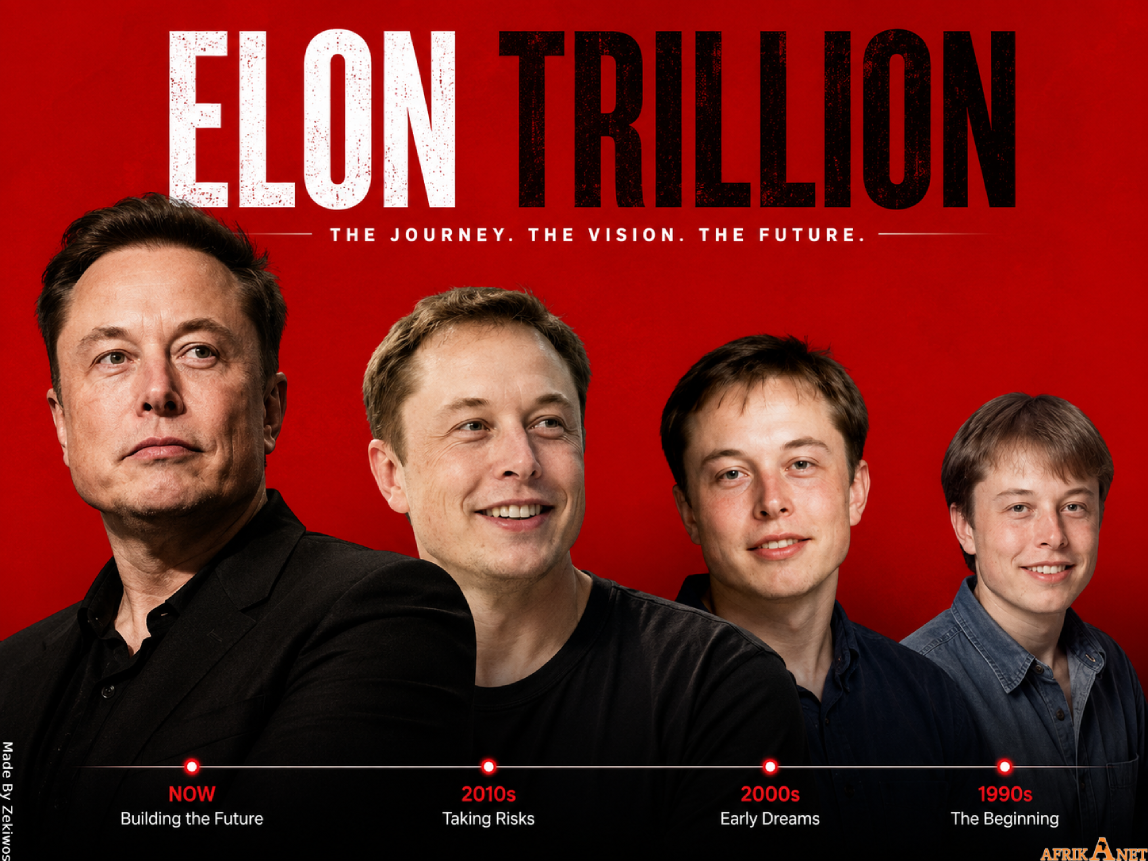
The word trillionaire doesn’t really belong to everyday language yet. It sounds like something borrowed from a future that hasn’t fully arrived. But every so often, a few names get pulled into that conversation anyway. One of them is Elon Musk.
Before the companies, before the valuations, and long before the global attention, there was just a kid in South Africa who spent most of his time inside books and computers.
Musk was born in Pretoria in 1971. His early life wasn’t shaped by privilege in the way people sometimes assume when they hear his name today. It was structured, strict, and often isolating. He read obsessively. Science fiction, engineering books, anything that suggested the world could be understood—or rebuilt—if you approached it the right way. That pattern doesn’t change much later in his life. The subjects change. The intensity doesn’t. By the time he was a teenager, he had already started coding. At 12, he created a simple video game called Blastar and sold it to a computer magazine. It wasn’t a life-changing amount of money, but it mattered in a different way: it was the first proof that ideas in his head could be turned into something external, something transferable.
School, however, didn’t fit neatly into that trajectory. There are well-documented accounts of bullying during his school years in South Africa. Whether those experiences define him is debatable, but they do explain something important: he developed a habit of retreating into systems—computers, physics, logic—where outcomes were predictable, unlike social environments.
At 17, he left South Africa. The decision wasn’t just about education. It was also about distance—geographic and personal. He moved first to Canada, partly because it was a gateway to North America, and partly because it offered a cleaner path toward the United States, where the technology ecosystem he was aiming for actually existed.
He studied at Queen’s University before transferring to the University of Pennsylvania. There, he ended up doing something that sounds almost ordinary on paper but matters in hindsight: he studied both economics and physics. That combination shows up later in everything he builds. Physics gives him comfort with systems and constraints. Economics gives him sensitivity to scale and incentives. After college, he briefly enrolled in a PhD program at Stanford. It lasted only a couple of days in any meaningful sense. The internet was beginning to accelerate, and he left almost immediately to join the wave instead of studying it from the side. That decision led to his first real company.
Zip2 was not glamorous. It was essentially a digital mapping and business directory service for newspapers—back when newspapers still needed help transitioning online. It sold for roughly $300 million in 1999. Musk’s share gave him his first significant financial base. More importantly, it gave him something else: confidence that software could be used to reshape legacy industries that didn’t yet realize they were already being replaced.
Then came X.com, which later became PayPal. This was a more direct confrontation with infrastructure. Money itself was the system. If you could improve how money moved, you weren’t just building a product—you were adjusting a layer of the economy. After PayPal was sold to eBay, Musk walked away with enough capital to stop thinking in terms of survival or small bets. From that point onward, the scale of his thinking changed.
This is where the story stops being linear.
In 2002, he founded SpaceX. The idea was not popular at the time. Private space companies were treated with skepticism, sometimes even dismissal. Rockets were considered a government domain, not a startup category. The early years were defined by failure—launches that didn’t work, vehicles that exploded, funding pressure that nearly shut the company down entirely.
But SpaceX didn’t adjust its ambition downward. Instead, it adjusted its tolerance for iteration upward. The focus was not on avoiding failure, but on making failure cheaper and faster to learn from. Eventually, that approach worked. Rockets started landing. Reuse became real. And suddenly, the cost structure of space stopped being fixed.
A similar pattern appears with Tesla, which Musk joined in its early stages and later became the central figure in. The company didn’t succeed because it built electric cars first. It succeeded because it stayed alive long enough for infrastructure—batteries, charging networks, software systems—to catch up with the idea. Again, the pattern is not invention alone, but persistence through a long gap between concept and viability.
What often gets missed in public perception is how repetitive his method actually is. He tends to enter industries where the physics is understood, but the economics are not yet solved. Then he pushes both at the same time. Not always smoothly. Not always predictably.
Later ventures extend this same logic into more abstract territory. Neuralink explores the boundary between biology and computation—how information might move directly between brains and machines. xAI, on the other hand, enters the increasingly competitive space of artificial intelligence, where the product is not physical infrastructure but cognitive capability at scale. At this point, the “trillionaire” conversation usually appears. But it’s important to notice how that framing distorts the actual mechanism at work.
The more accurate way to describe Musk’s trajectory is not that he builds companies to become extremely wealthy. It’s that he builds systems that, if they succeed, naturally become extremely valuable because they sit underneath other systems.
Tesla sits under transportation and energy. SpaceX sits under global communications and orbital infrastructure. Neuralink sits under the definition of human-machine interaction. xAI sits under information processing itself.
If even a fraction of those systems fully mature, the financial scale becomes a byproduct, not a target.
But none of this is guaranteed, and that’s where the narrative often gets simplified too aggressively in public discussions. These are long-duration bets with uncertain outcomes. They depend on engineering breakthroughs, regulatory environments, market timing, and sometimes sheer endurance through periods where progress is not visible from the outside.
So when people talk about a “first trillionaire,” it is less a forecast and more a shorthand for something broader: what happens when one individual consistently positions themselves at the intersection of multiple foundational systems during a period of technological transition.
Whether that ever resolves into a number is almost secondary. What’s already clear is that Musk’s life follows a pattern that is easier to see in hindsight than in real time: early discomfort with existing systems, movement toward technical depth, repeated entry into industries at moments of transition, and a willingness to operate through long periods where outcomes are uncertain and unpopular. That pattern, more than any valuation, is what keeps his name in the conversation at all.
And if the word trillionaire ever stops sounding like an exaggeration, it probably won’t be because the number changed. It will be because the systems underneath it finally did.