
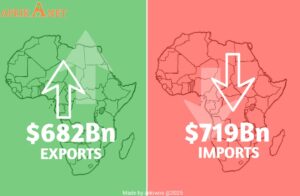
 Africa’s current trade pattern shows a structural imbalance: the continent exports mainly raw materials while importing the majority of its finished goods, machinery, and processed foods. In 2024, Africa exported approximately US$682 billion, but imported around US$719 billion, resulting in a trade deficit of about US$37 billion. This gap illustrates how much value Africa loses by not processing its own resources or producing the products it buys from abroad.
Strengthening manufacturing, expanding food-processing industries, and adopting modern technologies — especially AI-driven systems — are essential steps that can help African economies reduce imports, increase exports, and build long-term resilience.
1. What Africa Currently Exports — and Why It’s Not Enough
Africa’s export basket is dominated by primary commodities such as:
Minerals and metals: gold, copper, cobalt, lithium
Hydrocarbons: crude oil and natural gas
Agricultural raw materials: coffee, cocoa, tea, cotton
Unprocessed food crops: maize, cashew nuts, sesame, grains
These products are essential to global supply chains, but because they are exported raw, Africa earns only a fraction of their potential value. For example:
Cocoa is exported raw, while chocolate — made elsewhere — sells for 5–10× more.
Copper and cobalt are exported to make electronics, batteries, and electric cars — industries Africa could also enter.
Coffee beans earn little compared to Africa-branded processed coffee or packaged products.
The biggest challenge isn’t the amount exported — it’s the form in which exports leave the continent.
2. What Africa Imports — and Why It’s a Problem
Africa’s major imports include:
Electronics: phones, laptops, components
Food and packaged goods: pasta, wheat flour, oils, canned goods
Machinery and industrial equipment
Pharmaceuticals and medical supplies
Vehicles and spare parts
Textiles and finished clothing
When a continent with so many natural resources imports nearly all manufactured goods, it creates:
Currency pressure
High trade deficits
Little job creation
Weak industrial development
Dependence on global markets for basic needs
Reducing imports is not about isolation — it’s about producing locally where it is practical and profitable.
3. How Manufacturing Can Change Africa’s Economic Direction
Building manufacturing capacity would allow African countries to:
✔ Add value to raw materials
Turning:
gold → jewelry
cocoa → chocolate
coffee → packaged branded coffee
cotton → clothing
lithium/cobalt → batteries or components
creates multiple times more revenue.
✔ Create large-scale jobs
Factories require:
engineers
technicians
machine operators
supply chain specialists
logistics and packaging teams
Manufacturing jobs create stronger middle classes.
✔ Lower import dependency
Producing locally reduces the billions spent on foreign goods each year.
✔ Expand exports to regional and global markets
AfCFTA’s 1.3 billion-person market creates a massive demand for African-made goods.
4. Food Security as an Industrial Opportunity
Food imports remain a major cost for many African nations. But this is beginning to change.
Countries making progress:
Ethiopia: Major wheat production expansions. In some regions, wheat import dependence has significantly reduced due to irrigation and mechanized farming.
Egypt: Strong food-processing industries and greenhouse farming.
Morocco: Advanced irrigation systems and agri-tech solutions.
Rwanda: Using data, drones, and digital systems to boost yields.
Kenya: Strong agri-tech startups supporting farmers with AI-driven insights.
Food security isn’t only about producing enough food — it’s about processing it locally, packaging it, and selling it as finished goods rather than raw crops.
5. How AI and Technology Will Accelerate Africa’s Transition
AI gives Africa the chance to leapfrog older industrial stages and move directly into modern, efficient production systems.
✔ AI in Agriculture
Predicting droughts and rainfall
Identifying plant diseases early
Optimizing irrigation
Improving soil management
Reducing post-harvest losses
Monitoring yield in real time
This leads to more stable food systems and reduced import needs.
✔ AI in Manufacturing
Automated production lines
Real-time quality control
Predictive maintenance for machines
Supply chain optimization
Cost reduction in factories
This makes African manufacturing competitive with global producers.
✔ AI in Trade & Export Strategy
Forecasting global market demands
Pricing optimization
Identifying profitable export markets
Strengthening logistics networks
Improving packaging and certification
Enhancing branding and marketing
With AI, even small African producers can export globally.
6. Countries That Are Showing Real Industrial Potential
South Africa: established industrial base, automotive manufacturing, machinery.
Nigeria: growing non-oil exports like urea, cocoa processing, fertilizers.
Egypt: strong food industry, textiles, electronics assembly.
Morocco: automotive, aerospace parts, solar industries.
Ethiopia: textile industrial parks, agricultural processing.
Kenya: emerging tech manufacturing and agri-processing.
Ghana: cocoa processing, local brands, food industries.
Rwanda: tech-driven production and digital agriculture.
These countries show that industrialization in Africa is not theoretical — it is already happening.
7. What Africa Must Do Next
To shift from dependency to production, African nations should:
Expand local manufacturing zones
Invest in agri-processing industries
Strengthen energy infrastructure
Train youth in technical fields
Adopt AI tools across agriculture and factories
Promote regional trade through AfCFTA
Support SMEs with export incentives
These steps allow African products to compete globally.
Conclusion: A Practical Path to Reducing Imports
Africa has the resources, workforce, and market size to transform its economic structure. But real progress requires shifting from exporting raw materials to producing high-value goods — and from importing food and consumer products to manufacturing them locally.
With strategic investments in manufacturing, agriculture, food processing, and AI-driven systems, Africa can close the trade deficit, strengthen currencies, create millions of jobs, and build sustainable independence.
This path isn’t based on slogans — it’s based on practical, measurable action.

We need south south cooperation also and priority to local production over imported ones.
Why do we need to import our clothes ?
Why do we need to import our coffee and chocolate ?
Why do we need to import processed foods ?
All can be done in cooperation. Please call DANGOTE !!!!!
👍🏿
absolutely!!