------------------------------------------------------
Top 5 African Exporting Countries: 2024 Data and 2025 Trade Insights
Africa plays a key role in global merchandise trade, exporting a wide range of goods—from energy and minerals to manufactured products and agricultural commodities. According to the most recent full-year data, Africa’s total merchandise exports in 2024 were approximately $585.8 billion USD. While 2025 is nearing completion, the full-year figures are still being finalized. Preliminary indicators suggest that the trends from 2024 largely continue into 2025.
In this article, we explore the top five exporting countries in Africa, what they export, and why they lead the continent in international trade.
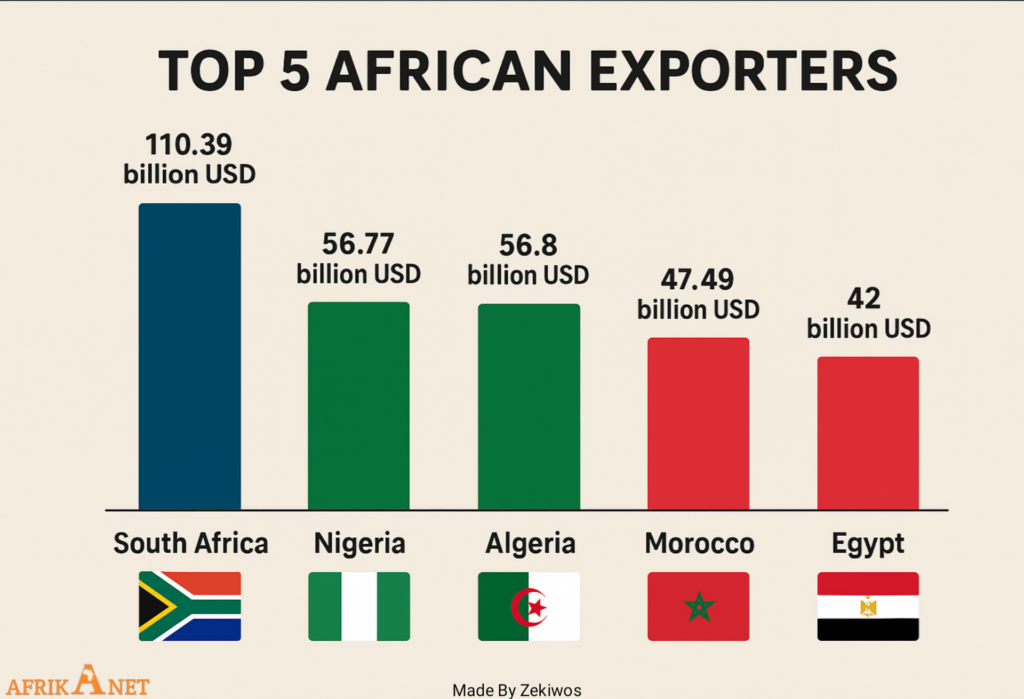
1. South Africa
Export Value: $110.39 billion USD
Key Exports: Gold, platinum group metals, diamonds, coal, iron ore, vehicles, machinery, electrical equipment, agricultural products, wine, fruit
South Africa is the largest exporter in Africa. Its strength comes from a highly diversified economy that combines natural resources with a strong manufacturing base. The country has a well-developed automotive industry, producing vehicles for global brands like Toyota, BMW, and Mercedes-Benz, which are exported worldwide.
Advanced ports such as Durban and Cape Town support trade with Europe, China, and the United States. This combination of natural resources, manufacturing, and logistics infrastructure secures South Africa’s leadership in African exports.
2. Nigeria
Export Value: $56.77 billion USD
Key Exports: Crude oil (dominant), cocoa, sesame seeds, cotton, rubber
Nigeria is Africa’s second-largest exporter, with an economy dominated by energy products, particularly crude oil. The country is one of Africa’s leading oil producers, supplying major markets such as India, Spain, and the Netherlands.
Efforts to expand non-oil exports—including agricultural commodities like cocoa, sesame seeds, cotton, and rubber—are increasing. Key ports, especially the Port of Lagos, help these products reach markets in Europe and Asia efficiently.
3. Algeria
Export Value: $56.8 billion USD
Key Exports: Oil, natural gas
Algeria closely follows Nigeria in export rankings. Its economy relies heavily on hydrocarbons, particularly oil and natural gas. Algeria is a top supplier of natural gas to Europe, with pipelines such as the Trans-Mediterranean Pipeline and Medgaz Pipeline connecting it to major European markets.
While agriculture and manufacturing are emerging sectors, Algeria’s energy partnerships with Europe sustain its export value and maintain its position as one of Africa’s largest exporters.
4. Morocco
Export Value: $47.49 billion USD
Key Exports: Vehicles, phosphates, fertilizers, textiles, electronics, citrus fruits, vegetables, seafood
Morocco has developed a diversified export base that includes manufacturing, agriculture, and minerals. The automotive sector is growing rapidly, producing vehicles mainly for European markets. Morocco also holds some of the world’s largest phosphate reserves, making fertilizers and phosphates key exports.
Industrial zones like Tanger-Med facilitate trade with Europe, Africa, and the Americas, strengthening Morocco’s export infrastructure and global reach.
5. Egypt
Export Value: $42 billion USD
Key Exports: Energy products, chemicals, textiles, food products, manufactured goods
Egypt rounds out the top five exporting countries in Africa. Its exports are diversified across energy, chemicals, textiles, food products, and manufactured goods. Egypt’s strategic location near the Suez Canal offers a major logistical advantage, connecting trade routes between Africa, Asia, and Europe.
Industrial expansion in chemicals, electrical goods, and textiles, combined with agricultural exports like citrus fruits and grains, ensures Egypt’s continued position as a leading exporter on the continent.
Why These Countries Lead Africa’s Exports
These five countries contribute a significant portion of Africa’s total merchandise exports. Their success reflects a combination of:
Natural resource wealth (South Africa, Nigeria, Algeria)
Manufacturing and industrial diversification (South Africa, Morocco, Egypt)
Strategic trade partnerships and logistics (Algeria, Morocco, Egypt)
Together, they shape Africa’s presence in the global trade landscape.
2025 Outlook
Although 2024 data provides the most complete picture, early 2025 indicators show that the rankings remain largely the same. South Africa continues to lead, followed by Nigeria, Algeria, Morocco, and Egypt. Regional trade agreements like the African Continental Free Trade Area (AfCFTA) are also strengthening intra-African trade, and diversification efforts in agriculture and manufacturing are gradually increasing export volumes in non-energy sectors.
Conclusion
Africa’s export landscape is both diverse and competitive. South Africa, Nigeria, Algeria, Morocco, and Egypt dominate merchandise exports, collectively shaping the continent’s contribution to global trade. From minerals and energy products to vehicles and agricultural goods, these nations demonstrate Africa’s growing influence in the international market.
While 2024 remains the most reliable full-year dataset, preliminary 2025 trends indicate continued growth and stability in Africa’s export leaders.
Sources: